Arizona Polyurea Coatings Editorial Team · Published August 1, 2026 · 8 min read
Most people picture Arizona agriculture as a rounding error next to the state's population centers. It isn't. Directional figures from university economic-impact research put Arizona agriculture's total economic footprint at roughly $31 billion, with roughly $5.4 billion in direct annual cash receipts in the most recent full-year breakdown available. Dairy products and cattle & calves sit near the top of the state's commodity list by value, alongside vegetables, greenhouse and nursery products, and cotton — a genuinely large, concentrated industry operating statewide, not just in a few farm towns.
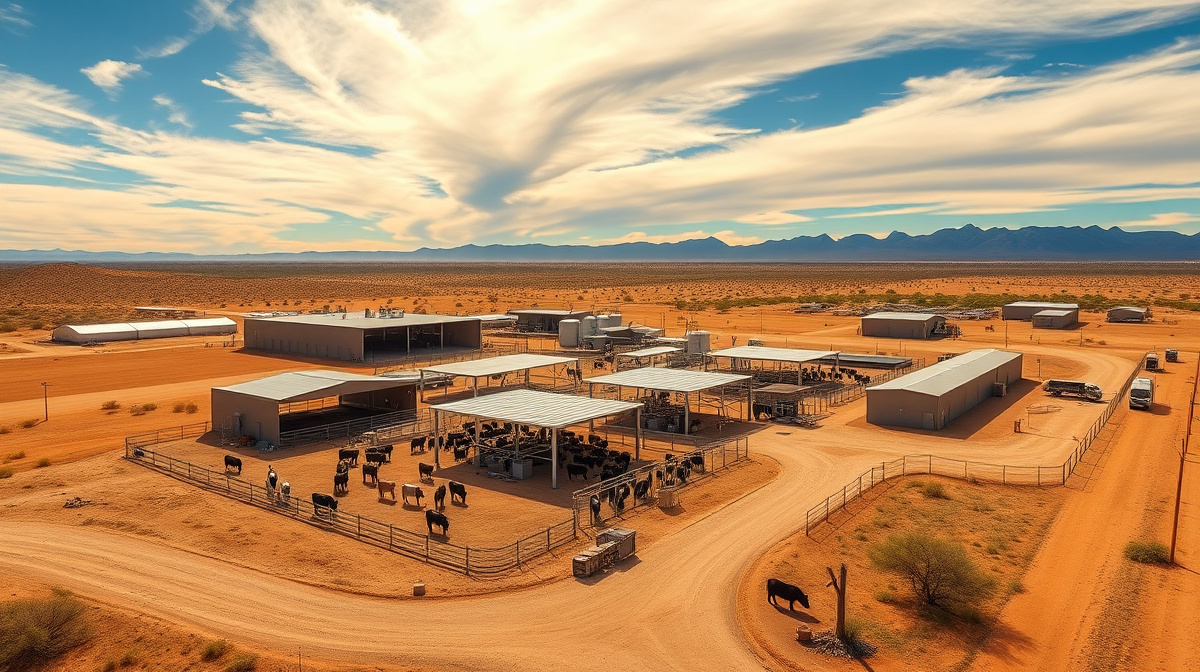
What makes Arizona's agricultural sector different from a lot of other states isn't only the dollar figure — it's the scale of each individual operation. Arizona dairies run unusually large, averaging somewhere in the range of 1,500 to 2,000 cows per facility, compared with a national average closer to 100 to 150 cows per dairy. Translated into infrastructure terms: Arizona has fewer dairies, but each one carries proportionally larger tanks, lagoon liners, and feed-lane square footage than a small operation elsewhere in the country would ever need. Layer cotton ginning and packing facilities and large cattle-feeding operations on top of that picture, and the pattern across the state is consistent — a relatively small number of very large, very active facilities running daily wash-down, animal traffic, and waste-handling cycles that most concrete and paint systems were never built to survive.
Where bare concrete and painted coatings stop being a one-time cost
On paper, a bare concrete floor or a thin painted topcoat look like the budget option. On an active dairy parlor, feedlot loadout pad, or lagoon liner, they almost never stay that way — they turn into a recurring line item instead of a one-time job.
A few things drive that, and they're specific to how an ag or livestock facility actually operates day to day:
- ✓Daily wash-down chemistry — chlorinated cleaners and high-pressure water break down typical sealers and thin-mil coatings over repeat cycles, opening hairline cracks that let moisture migrate underneath the surface.
- ✓Constant animal-waste exposure — manure solids and the organic acids in waste runoff accelerate concrete surface breakdown far faster than a dry industrial floor ever experiences.
- ✓Heavy daily traffic — cattle hooves, mixer wagons, front-end loaders, and forklifts in loadout areas wear through a thin topcoat in a fraction of the time it takes on a standard warehouse floor.
- ✓Statewide temperature swings — Phoenix and Yuma summer heat and Flagstaff-area winter cold both stress rigid coating systems that weren't formulated for a wide application-temperature window.
Put those four factors together on a facility that runs every single day of the year, and the math changes fast. A repaint or reseal cycle every couple of years isn't just a materials cost — it's facility downtime that a dairy parlor, feedlot, or cotton-processing floor running on a daily schedule can't easily absorb.
Why true polyurea holds up where paint and epoxy don't
True, spray-applied polyurea is a genuinely different category of material from epoxy or polyaspartic — and the differences map almost exactly onto what an Arizona ag or livestock facility deals with every day.
It gels in seconds and reaches a tack-free, walkable state within minutes to about an hour, which is the entire reason fast return-to-service is possible on a working facility at all. It also commonly elongates several hundred percent before failure, letting a seamless membrane bridge hairline cracking and absorb slab or tank-shell movement instead of cracking along with it — a real mechanical advantage on structures that flex with temperature and load. Because it's spray-applied, it forms a fully-bonded, monolithic membrane with no seams for waste or moisture to migrate through, which is exactly why it's the correct category for tank and lagoon linings, not just a floor topcoat. It resists a broad range of acids, fuels, and industrial chemicals along with high-abrasion traffic from cattle, equipment, and vehicles, and its cure chemistry is far less sensitive to substrate and ambient temperature swings than epoxy — which matters on a statewide operation running facilities from Yuma's summer heat to Flagstaff's winter cold, not a single-city footprint.
Ordinary epoxy and paint systems were built for a controlled indoor environment — a warehouse floor or a garage slab that sees vehicle traffic and not much else. Ask the same rigid, seam-dependent chemistry to hold a lagoon full of waste runoff, bridge a hairline crack in a tank shell that flexes with temperature, or survive three wash-downs a day with chlorinated cleaner, and it simply wasn't formulated for the job. That mismatch — not poor workmanship — is the real reason so many ag facilities end up on a repeat repaint cycle instead of a system that lasts.
Where a seamless polyurea system gets used on an ag or livestock facility
The same seamless, fast-cure system applies across the areas of a working ag or livestock facility that see the heaviest combination of moisture, waste exposure, and traffic:
- ✓Feed troughs and feed lanes — high-traffic surfaces exposed to feed acids, moisture, and constant animal contact throughout the day.
- ✓Tank and lagoon linings — seamless, fully-bonded membranes for waste-storage tanks and lagoons where a seamed liner system would otherwise give moisture and waste solids a migration path.
- ✓Wash-down and milking-parlor floors — surfaces cleaned multiple times a day with high-pressure water and cleaning chemistry, needing a membrane that won't degrade or delaminate under repeat cycles.
- ✓Loadout and equipment areas — heavy-vehicle and equipment traffic zones where abrasion resistance determines how long a floor system actually lasts between service calls.
Fast cure means less time off the line
A dairy, feedlot, or cotton-processing operation doesn't have the option of shutting down for a week while a floor or tank lining cures. That's the practical reason cure speed matters as much as chemical resistance on these projects. Because a true polyurea system reaches a walkable, load-ready state in minutes to about an hour rather than the multi-hour-to-day window epoxy needs, work can be scheduled in off-hours windows, section by section, so the rest of the facility keeps running while one area is being recoated. For an operation that processes milk, feeds livestock, or moves product every day of the year, that difference between an overnight job and a multi-day shutdown is often the deciding factor in which coating system actually gets specified.
What a site assessment looks like on a working facility
Because a dairy, feedlot, or cotton facility can't simply close its doors while a coating system goes down, the process starts with understanding how the facility actually runs before a single surface gets touched. A site assessment looks at which tanks, lagoons, feed lanes, or floor areas are due for a system, what the existing substrate condition is, and what daily traffic and wash-down schedule the crew needs to work around. From there, surface preparation and substrate testing confirm the concrete or steel is ready for a fully-bonded membrane, the plural-component polyurea is spray-applied in the sequence that keeps the rest of the facility operating, and cure verification and documentation close out the job so the operator has a clear record of what was installed and where.
That sequencing — assessment, prep, application, verification — is the same process used across every line of business, scaled to an ag or livestock facility's specific layout: tank and lagoon shells, feed lanes and troughs, milking-parlor and wash-down floors, and loadout and equipment pads.
Serving dairies, feedlots, cotton operations, and rural sites statewide
Because Arizona's largest ag and livestock operations are spread across the state — dairy and cattle country around the Phoenix and Tucson regions, cotton ginning and packing tied to the Yuma agricultural belt, and rural operations in between — a statewide dispatch model matters more here than it would for a metro-only trade. That reach also covers higher-elevation rural sites around Flagstaff and northern Arizona, where winter cold makes a temperature-tolerant application window just as important as it is in Yuma's summer heat. We work directly with the facility or operations manager to scope tank, lagoon, feed-lane, and floor projects sized to the operation, back the finished work with a written warranty, and schedule application around a facility that has to keep running every day, not just on a convenient week.
For the full picture of how this fits into the broader lineup of industrial and infrastructure coating work across the state, see the statewide guide to polyurea industrial, infrastructure & agricultural coatings. For the full detail on this specific service line — including how a site assessment works for a dairy, feedlot, or cotton facility — visit the Agricultural & Livestock Facility Coatings service page.