Municipal, District & Utility Infrastructure
Water & Wastewater Infrastructure Polyurea Coatings
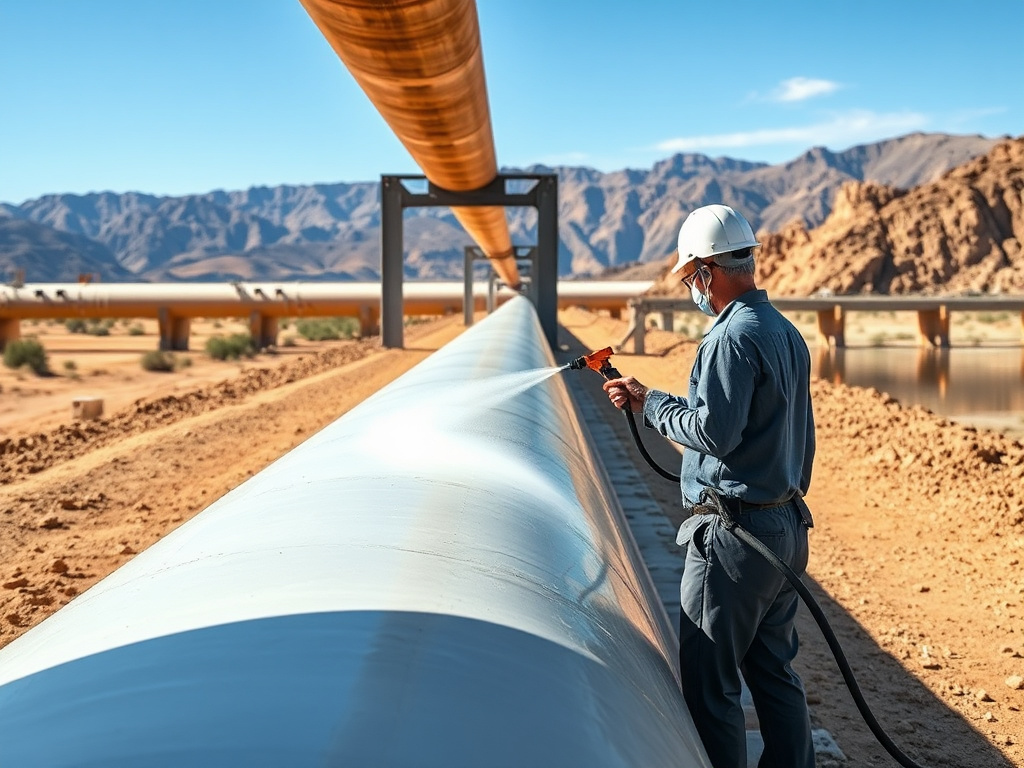
Tanks, canals, culverts, and treatment structures all share the same weak point in most liner systems — the seam. We spray a seamless, fully-bonded polyurea membrane built for water infrastructure that has to hold up statewide, from a municipal reservoir to an agricultural canal segment.
An active investment cycle
Arizona's water infrastructure is being rehabilitated and expanded right now
Arizona's municipal and agricultural water supply runs through some of the largest engineered water infrastructure in the country. The Central Arizona Project moves Colorado River water across roughly 336 miles of canal through 14 pumping plants, supplying both municipal systems in the Phoenix and Tucson metro areas and approximately one million acres of irrigated agricultural land in Maricopa, Pinal, and Pima counties. That's a genuinely large, continuously operating asset base of canals, pump stations, and connected tank and pipeline infrastructure.
That system is also actively being expanded. A coalition of central-Arizona municipalities and water companies has secured federal funding to interconnect the Central Arizona Project and Salt River Project canal systems, and a new SRP pipeline tied to that effort recently went into service to improve access to stored groundwater during dry periods. Investment cycles like this one tend to bring tank, canal, and pipeline rehabilitation work along with new construction — a pattern worth flagging for anyone specifying materials for the tanks, lift stations, and canal segments that make up this network.
We'd stop short of citing specific rehabilitation-project counts or timelines beyond what's publicly documented — those specifics are set by each municipality, district, or agency's own capital planning, not something we'd represent on their behalf. What is fair to say, directionally, is that Arizona's water infrastructure sits inside an active, ongoing cycle of tank, canal, and pipeline work statewide, and that a seamless, fast-curing membrane is a genuinely good fit for that kind of asset — a tank or canal segment can be relined and back in service in a fraction of the time a seamed or epoxy-based system would need.
For more on the canal-system context specifically, see our companion blog post on how Arizona's water systems use polyurea to stop leaks and extend asset life.
Where the membrane fits
Tanks, canals, culverts, lift stations, and treatment structures
Water and wastewater infrastructure covers a wide range of structure types, and a seamless polyurea membrane applies across nearly all of them because the failure mode it solves — seam degradation and water migration through a joint — is common to all of them. The specific material system, thickness, and potable-contact rating change by structure and use, but the underlying case for a monolithic, fully-bonded membrane doesn't.
We treat each structure type as its own scope during assessment rather than applying one blanket spec across an entire site.
- ✓Potable and non-potable water storage tanks
- ✓Secondary and agricultural irrigation canals
- ✓Culverts and box culverts
- ✓Lift stations and wet wells
- ✓Treatment-facility structures — clarifiers, basins, and containment areas
- ✓Below-grade and buried structure waterproofing
Waterproofing performance
A monolithic membrane vs. a seamed liner system
The core performance question for any water-holding or water-conveying structure is simple: does the lining stay intact and watertight over time, or does it eventually leak at a joint. That's the actual comparison worth making — not a generic materials comparison, but a seams-vs-no-seams comparison specific to how these structures actually fail.
| Membrane structure | Spray-applied polyurea forms one continuous, fully-bonded membrane over a tank, canal section, or culvert. Sheet and panel liner systems rely on field-welded or adhesive-bonded seams between individual panels. |
|---|---|
| Where seams typically fail | Seamed liner systems most often fail at the seam itself — a welded or bonded joint that degrades under UV exposure, ground movement, or repeated wet/dry cycling. A seamless membrane removes that specific failure point. |
| Flexibility under movement | True polyurea's high elongation lets it flex with minor settling, thermal movement, or hairline cracking in the concrete or earthen structure beneath it, instead of splitting the way a rigid coating would. |
| Cure and return-to-service | Polyurea gels in seconds to minutes and is typically walkable within about an hour, letting a tank or canal section return to service far faster than epoxy-based or field-welded liner systems. |
| Material selection for potable contact | Where a structure holds potable water, an appropriate potable-contact-rated material system is confirmed and selected during assessment — this is a per-project material decision, not a default assumption. |
General patterns for a seamless, spray-applied polyurea membrane versus field-welded or panel-seamed liner alternatives — final material spec is confirmed per structure during assessment.
Chemical and abrasion resistance
Built for wastewater and treatment-facility exposure, not just clean water
Wastewater and treatment-facility environments expose a lining to more than standing water. Clarifiers, basins, and containment areas at a treatment facility see a mix of biological waste, disinfection chemicals, and abrasive solids moving through the structure continuously. A lining that only holds up to clean water doesn't hold up in that environment for long.
True polyurea's chemical resistance profile and abrasion resistance were both established for genuinely demanding industrial exposure, which is why the same material category that lines a chemical containment berm also holds up inside a treatment basin or a wastewater lift station.
Canals and culverts add a different kind of wear — sediment, debris, and seasonal flow variation moving across the membrane surface for years at a stretch, plus direct sun exposure on open canal sections. A seamless membrane that also resists abrasion and UV degradation is the right combination for that environment, rather than a lining chosen for waterproofing alone.
For a closer look at how a related seamless-membrane case applies to chemical exposure specifically, see our secondary containment & chemical-resistant coatings page.
How a municipal or district project runs
Assessment through inspection and documentation
Municipal, district, and utility projects follow a bid process rather than an instant quote, and the material specification step is more involved than on a typical commercial job — potable-contact requirements, structure geometry, and access all factor in before a bid goes out.
Structure assessment
Document the tank, canal segment, culvert, or treatment structure — dimensions, substrate condition, and current or intended water contact use.
Material specification
Select the appropriate material system, including potable-contact-rated products where the structure holds drinking water.
Surface preparation
Prepare the substrate — concrete profiling, repair of spalled or cracked areas, and cleaning — before application begins.
Spray application
Apply the seamless polyurea membrane across the full structure, including corners, penetrations, and transition details.
Inspection & documentation
Verify cure and film thickness, then document the application for the municipality, district, or utility's own records.
Keeping infrastructure in service
Minimizing service interruption on active water infrastructure
A municipal water tank or an active irrigation canal segment isn't a structure that can sit offline for an extended relining project — downstream users depend on it. Fast cure is what makes a short, defined outage window realistic instead of a multi-day or multi-week shutdown.
Seconds
Typical gel time
~1 hour
Tack-free & walkable
Zero
Seams in the membrane
Statewide
Mobile spray dispatch
We plan tank and canal relining around the shortest outage window that's realistically achievable — often working sections of a canal or a single tank at a time so the broader system stays in service throughout the project, and scheduling around low-demand periods where a district's own operations allow for it.
Common questions
Water & wastewater infrastructure coating — frequently asked
Can polyurea be used inside a potable water tank?
+
Yes, with an appropriate potable-contact-rated material system. The specific product used inside a tank that holds drinking water is confirmed and selected on a per-project basis during assessment, not assumed from our general coating line.
Is polyurea suitable for lining irrigation canals or culverts?
+
Yes. Its seamless, flexible, fully-bonded membrane fits canal and culvert environments well, since joints and seams are typically the first place those structures develop leaks over time.
How fast can a water tank or canal section return to service after coating?
+
Because polyurea cures in minutes rather than the days a field-welded liner or epoxy system can need, tanks, canals, and culvert sections typically return to service far faster, which matters on infrastructure that a municipality or district can't take offline for long.
Do you work directly with municipalities and water districts on bid projects?
+
Yes. The commercial and municipal bid process covers a facility or structure assessment, material specification (including potable-contact considerations where relevant), and scheduled application for public and district infrastructure projects.
Request a bid for a municipal, district, or utility project
Tell us about the tank, canal, culvert, or treatment structure and its water-contact use. We'll scope material specification and an outage-minimizing schedule before you get a bid.
Related reading
Go deeper on seamless polyurea for infrastructure work
Secondary Containment & Chemical-Resistant Coatings
The same seamless-membrane case applied to containment berms, tank farms, and chemical-processing floors.
About Arizona Polyurea Coatings
A true-polyurea specialty contractor, licensed and bonded, serving municipal, industrial, and agricultural sites statewide.
Polyurea for Arizona’s Industrial, Infrastructure & Agricultural Sectors
The full statewide guide, including the Central Arizona Project canal-system context in more depth.
How Arizona’s Water Systems Use Polyurea to Stop Leaks and Extend Asset Life
The Central Arizona Project's canal system and the active 2026 CAP–SRP interconnection investment, explained.