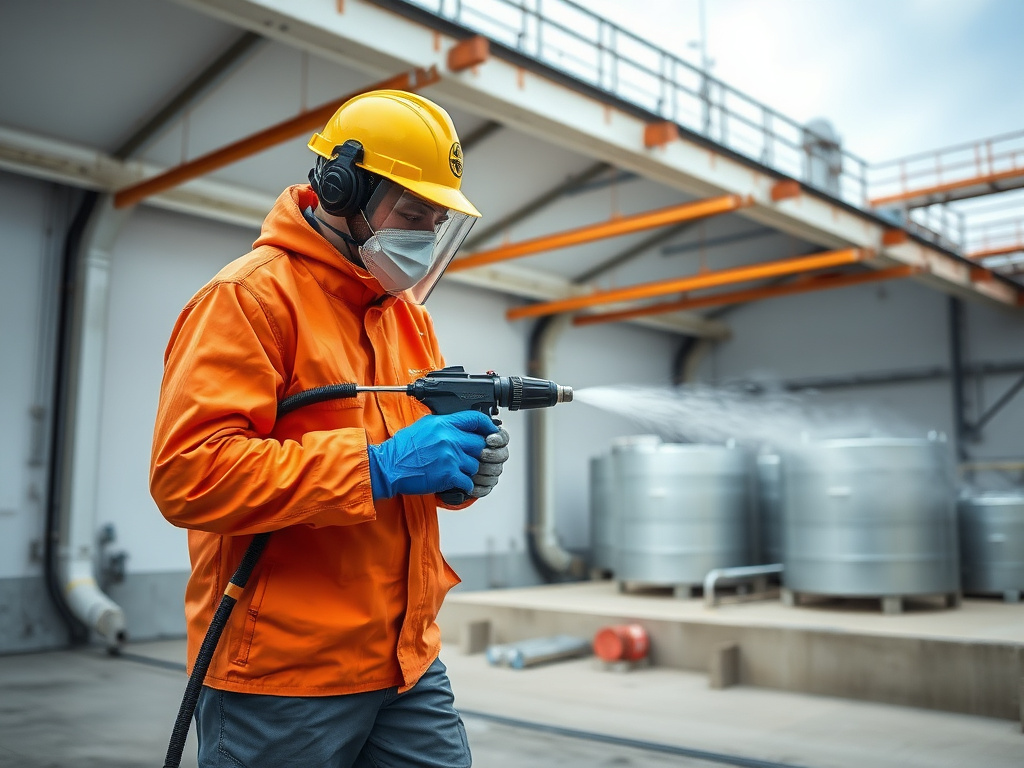
Industrial & Chemical-Processing Facilities
Secondary Containment & Chemical-Resistant Polyurea Coatings
A containment structure only does its job if the liner inside it never leaks — and the liner's weakest point is almost always a seam. We spray a seamless, fully-bonded polyurea membrane that gives chemical, fuel, and processing facilities a lining with nowhere for a spill to migrate through.
What secondary containment coating is
A seamless liner, not a painted-on barrier
Secondary containment exists for one reason: if a tank, drum, or process line ever leaks, the surrounding berm, dike, or containment floor is the backup that keeps the spill from reaching soil or groundwater. That backup only works if the lining inside the containment structure holds up under real chemical exposure and never gives a spill a path out through a seam or a crack.
A lot of containment structures are lined with a thin coating of paint, a field-seamed sheet membrane, or a rigid epoxy topcoat. Each of those approaches has a real weak point — paint wears through under repeated exposure, sheet liners depend on the integrity of every seam and every seam is a place chemical can eventually work its way through, and rigid epoxy can crack where the concrete or steel underneath it flexes or settles.
A spray-applied polyurea membrane is different in kind, not just in degree. Because it's applied as a plural-component spray rather than rolled or sheeted into place, it forms one continuous, fully-bonded layer over the entire berm wall, floor, or dike — corners, penetrations, and transitions included. There's no seam anywhere in the membrane for a chemical to find.
That's the starting premise for every containment project we scope: the lining system has to match the chemical exposure and the structure's movement, not just look finished on handoff day. For the water-side version of this same seamless-membrane case, see our water & wastewater infrastructure coatings page.
Why true polyurea, specifically
The material case for chemical exposure
This isn't a three-way comparison between epoxy, polyaspartic, and polyurea for a floor that mostly sees foot traffic and the occasional oil stain. Containment and chemical-processing environments put real, sustained chemical exposure on a lining, and that changes which material actually belongs in the conversation.
| Seam behavior | Spray-applied polyurea forms a single monolithic membrane with no seams. Sheet liners and field-seamed systems rely on adhesive or heat-welded joints — the point where most containment-liner failures actually start. |
|---|---|
| Chemical exposure | True polyurea resists a broad range of acids, fuels, solvents, and other industrial chemicals. The correct formulation is confirmed against the specific chemical inventory at the facility before a material is specified. |
| Cure and return-to-service | Plural-component polyurea gels in seconds to minutes and reaches a tack-free, walkable state within roughly an hour, versus a multi-hour-to-day cure window for epoxy-based liner systems. |
| Elongation and movement | True polyurea can elongate several hundred percent before failing, letting it bridge hairline cracks and absorb minor structural movement in concrete berms and steel containment walls without splitting. |
| Temperature range for application | Polyurea's reaction chemistry tolerates a much wider substrate and ambient temperature range than epoxy, which matters on a statewide schedule that runs from Yuma summer heat to Flagstaff winter cold. |
General patterns for true, plural-component polyurea versus sheet-liner and epoxy alternatives — the exact material spec for a given facility is confirmed during assessment against its chemical inventory.
Where this applies
Containment berms, dike walls, tank farms, and processing floors
Secondary containment and chemical-resistant coating work covers a range of structures at an industrial or chemical-processing site, and they don't all see the same exposure. A containment berm around a bulk storage tank mostly needs to hold up to an occasional, contained spill event. A loading and unloading pad sees regular, direct chemical contact from routine transfer operations. A processing floor inside an active plant can see constant foot and vehicle traffic on top of chemical exposure, which is why abrasion resistance matters just as much as chemistry there.
We scope the coating spec to the specific structure and its actual use, not a single generic "containment coating" applied the same way everywhere on a site.
- ✓Containment berms and dike walls around above-ground and bulk storage tanks
- ✓Chemical and fuel loading/unloading pads
- ✓Tank farm perimeter walls and containment floors
- ✓Chemical storage and processing building floors
- ✓Secondary containment for drum storage and satellite accumulation areas
- ✓Transition and penetration detail work where pipes, sumps, or equipment pass through a containment structure
Downtime that actually matters
Fast return to service, not a multi-day shutdown
Most facilities don't have a spare containment structure to route production through while a liner cures for a few days. A fast-curing membrane is what makes recoating an active berm, tank farm, or processing floor practical without a long shutdown.
Seconds
Typical gel time
~1 hour
Tack-free & walkable
Zero
Seams in the membrane
Statewide
Mobile spray dispatch
Epoxy-based containment liners typically need a multi-hour-to-day cure window before they can safely handle chemical exposure or foot traffic again. Polyurea's plural-component spray chemistry gels almost immediately and reaches a walkable state in roughly an hour, which is the difference between coating a containment structure over a weekend and taking a working area out of service for most of a week.
Getting the substrate right
Surface preparation and substrate testing for concrete and steel
A seamless membrane is only as good as its bond to the substrate underneath it. Containment structures are built from concrete, steel, or a combination of both, and each substrate needs its own preparation approach before polyurea goes on.
Site assessment
Walk the containment structure, document its dimensions, and confirm the chemical inventory it needs to resist before any material is specified.
Substrate testing
Test concrete moisture and profile, or steel surface condition and any existing coating, to confirm what the polyurea needs to bond to.
Surface preparation
Grind, shot-blast, or otherwise profile the substrate, and repair spalled concrete or corroded steel before coating begins.
Spray application
Apply the plural-component polyurea membrane in a continuous pass over walls, floors, corners, and penetrations.
Cure verification & documentation
Confirm cure and film thickness, then document the application for the facility's own maintenance and inspection records.
Working inside an active facility
Coating around operations that don't stop for a project
Chemical and industrial facilities rarely have a convenient window where everything can shut down for a coating project. A tank farm still needs to receive deliveries, a processing floor still needs to run its shift, and a loading pad still needs to move product. We plan around that reality rather than asking a facility to work around us.
Phased application is the usual approach — coating one containment section, bay, or floor zone at a time so the rest of the facility keeps operating. Off-hours and weekend scheduling extends that further for facilities that need daytime operations left untouched entirely.
Because polyurea's fast cure lets a coated section return to service in roughly an hour rather than days, a phased schedule actually works in practice — a section coated overnight can often be back in rotation the next morning, which keeps a multi-phase project from stretching into a multi-week disruption.
We build this schedule during the assessment, not after a crew shows up, so facility managers know exactly which section is offline, for how long, and when the next phase starts.
Common questions
Secondary containment coating — frequently asked
What is secondary containment coating, and when is it needed?
+
It's a seamless, chemical-resistant lining applied to berms, dikes, or containment structures around chemical or fuel storage so that a leak or spill is captured rather than reaching soil or groundwater. The specific containment requirement for a given tank, berm, or storage area is set by facility engineering and the applicable regulatory agency — we work from whatever spec the facility and its engineers have already established, or help identify the right questions to ask if that spec hasn't been defined yet.
Why use polyurea instead of a sheet liner or epoxy coating for containment?
+
Sheet liners depend on field seams, and seams are the most common place a containment liner eventually fails. A sprayed polyurea membrane is fully bonded to the substrate with no seams at all, and it resists the acids, fuels, and solvents typical of chemical storage and processing environments better than most epoxy systems, with far more flexibility to handle minor substrate movement.
How fast can a containment structure return to service after coating?
+
Because polyurea gels in seconds and is typically walkable within about an hour, containment structures and processing floors generally return to service far faster than with an epoxy-based system, which can need days to fully cure before it's ready for chemical exposure or traffic.
Can you coat an active facility without a full shutdown?
+
In most cases, yes. Phased application and off-hours scheduling let containment structures, tank farms, and processing floors get coated section by section while the rest of the facility keeps running. We scope this during the site assessment, not after a crew is already on site.
Get a site assessment for your containment project
Tell us about the structure, its chemical inventory, and your operating schedule. We'll come back with a scoped material spec and a bid — no obligation.
Related reading
Go deeper on seamless polyurea for industrial and infrastructure work
Water & Wastewater Infrastructure Coatings
The same seamless-membrane case applied to tanks, canals, culverts, and treatment facility structures statewide.
About Arizona Polyurea Coatings
A true-polyurea specialty contractor, licensed and bonded, serving industrial, municipal, and agricultural sites statewide.
Polyurea for Arizona’s Industrial, Infrastructure & Agricultural Sectors
The full statewide guide to true polyurea across containment, water infrastructure, agriculture, fleet, and parking structures.
Secondary Containment Coatings 101
What Arizona chemical and manufacturing facility managers should know before specifying a containment liner.