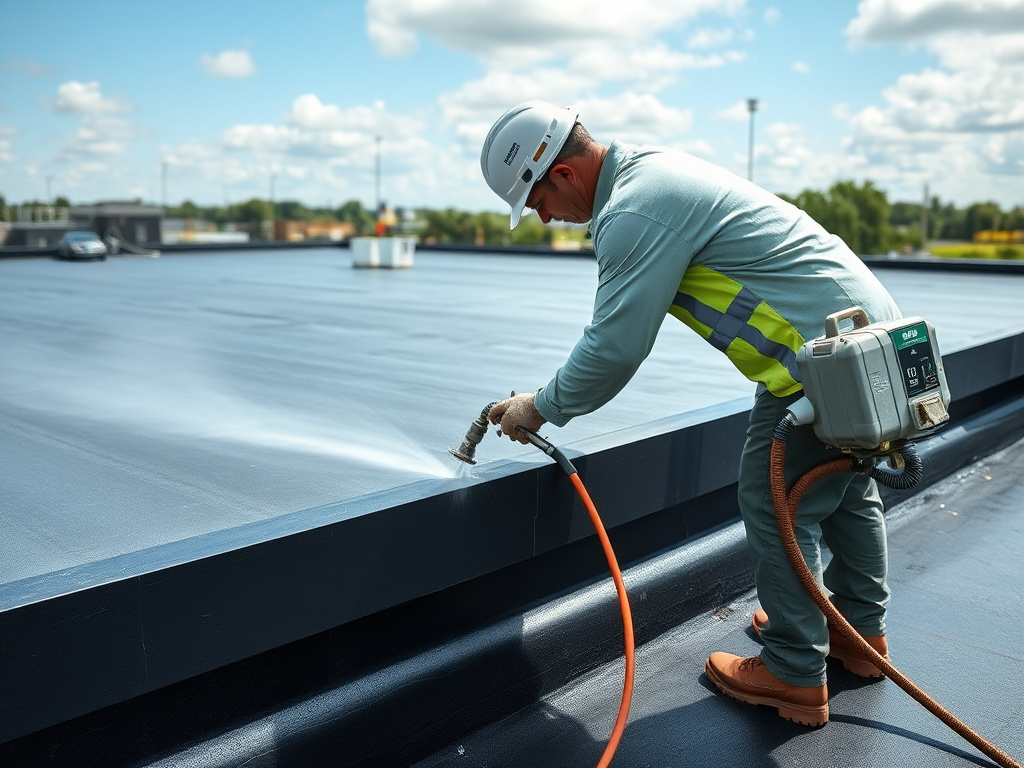
Roofing & Waterproofing
Polyurea Roofing & Waterproofing Membrane Coatings
A spray-applied polyurea membrane waterproofs a roof or structure the way a liquid can and a sheet system can't — as one continuous, fully-bonded layer with no seams, following every parapet, curb, and penetration detail along the way.
Why a seamless membrane matters
Most roof leaks start at a seam. A polyurea membrane doesn't have one.
A commercial roof or waterproofing assembly almost always fails at the joint, not in the open field of the material. Sheet-good roofing systems, seamed liners, and modified-bitumen rolls all depend on lapped joints, mechanical fasteners, or adhesive strips to tie one section to the next, and every one of those joints is a place where water intrusion can begin. A plural-component, spray-applied polyurea system is built the opposite way: the two reactive components mix at the spray tip and gel in seconds to minutes as they're applied, forming one continuous, fully-bonded membrane across the roof deck, parapets, flashing details, and penetrations with no seams anywhere in the system.
That difference matters more on a roof than in almost any other application. A roof deck moves — thermally, structurally, under wind load and foot traffic — every day it's in service, and it's exposed to the full range of Arizona surface temperatures, from summer rooftop heat well above what a hand can tolerate in Phoenix and Yuma to winter cold at elevation around Flagstaff. A monolithic membrane chemically bonded to the substrate doesn't have a joint to open up under that movement. A seamed system does, and that's where most roof leaks originate over the working life of the assembly.
Because polyurea is spray-applied rather than rolled out as pre-formed sheet goods, it also follows complex roof geometry the way a liquid can and a sheet system can't. Parapet walls, curbs, drains, pipe penetrations, and transition details all receive the same continuous membrane as the open field of the roof, instead of a separate flashing product stitched in at every corner and detail — historically one of the most common places a conventional roof system develops an early leak.
The same fully-bonded, seamless property is what makes polyurea membranes a fit well beyond roofing itself — below-grade and foundation waterproofing, water-feature linings, and other waterproofing assemblies where a joint-free barrier is the whole point of the system, not a nice-to-have. For the mechanical case behind why polyurea behaves this way, see our overview of how we approach true polyurea application statewide.
Handling movement without cracking
Elongation and flexibility: the mechanical case for a roof membrane
A rigid coating and a spray-applied polyurea membrane can look almost identical the day they're installed. The difference shows up months or years later, once thermal cycling, structural settling, and building movement have had time to work on the material. True polyurea commonly elongates several hundred percent before it fails, which lets a roof membrane stretch and recover with that movement instead of splitting at a stress point the way a rigid film does.
That flexibility is also what lets a single membrane bridge small existing cracks in an old roof deck or waterproofing substrate without a separate crack-repair step becoming its own point of future failure. Combined with a wide temperature-tolerant application window, it's the reason a spray-applied polyurea system holds up statewide — on a metal warehouse roof baking through a Phoenix or Yuma summer and on a structure exposed to freeze-thaw cycling around Flagstaff — without the scheduling constraints a temperature-sensitive epoxy system imposes.
| Application method | Plural-component, spray-applied — the two reactive components mix at the spray tip and gel in seconds to minutes as they're applied, rather than being rolled out as pre-formed sheet goods. |
|---|---|
| Seam condition | None in the field of the membrane. Roof deck, parapet, flashing, and penetration details all receive the same continuous, fully-bonded coating rather than separate sheet sections joined by laps, tape, or adhesive strips. |
| Flexibility / movement | High elongation before failure — commonly several hundred percent — lets the membrane stretch and recover with thermal expansion, structural flex, and vibration instead of splitting the way a rigid coating does. |
| Return-to-service window | Tack-free and walkable within about an hour in most conditions, versus a multi-hour-to-day cure window for built-up or epoxy-based waterproofing systems. |
| Temperature tolerance | The reaction chemistry is far less sensitive to hot or cold substrate and ambient conditions than epoxy, supporting application from Yuma summer heat to Flagstaff winter cold within the same statewide operation. |
General properties of a plural-component polyurea membrane system, confirmed against the specific roof or waterproofing assembly during a site assessment.
Where this membrane fits
Roofing and waterproofing applications, statewide
A seamless, fully-bonded membrane isn't only a roofing product — it's a waterproofing category that applies anywhere a joint-free barrier is the actual requirement, not an afterthought bolted onto a sheet system.
- ✓Commercial and industrial roofing — low-slope and metal roof systems needing a continuous waterproof membrane rather than a patched sheet system
- ✓Parapet walls, curbs, and flashing detail work, where a spray-applied membrane follows complex geometry a rolled sheet can't reach cleanly
- ✓Below-grade and foundation waterproofing for structures needing a fully-bonded barrier against ground moisture and hydrostatic pressure
- ✓Water-feature and reservoir linings — decorative ponds, retention features, and small reservoir structures needing a seamless, flexible waterproof membrane
On commercial and industrial buildings, that most often means a low-slope or metal roof system where ponding water and thermal cycling wear out a seamed system over time. On water-feature and reservoir linings, it means a continuous barrier that doesn't rely on a seam holding under constant hydrostatic pressure. The underlying material and application process are the same across every one of these use cases — what changes is surface preparation, detail work, and topcoat selection for the specific exposure.
Built for exterior exposure
UV-stable topcoats for long-term Arizona exterior exposure
A base polyurea membrane is chosen for mechanical performance — flexibility, fast cure, and a fully-bonded seal — but a roof or exterior waterproofing assembly also spends years under direct Arizona sun. Left unprotected, some base polyurea chemistries can chalk or shift color under sustained ultraviolet exposure over time, which is a cosmetic and topcoat question rather than a structural one, but it's still worth addressing correctly.
A UV-stable aliphatic topcoat applied over the base membrane addresses that exposure directly, protecting the finish and appearance through years of exterior sun without changing the underlying membrane's waterproofing performance or flexibility.
Because the state's exterior exposure conditions vary meaningfully by region — sustained high-UV, high-heat exposure around Phoenix and Yuma versus a higher-elevation, wider seasonal swing around Flagstaff and northern Arizona — topcoat selection is part of the same site assessment that determines the base membrane specification, not a separate afterthought.
The result is a roofing or waterproofing system built for the specific exterior exposure of the site it's installed on, statewide, rather than a single one-size-fits-all product applied the same way everywhere.
Extending an existing roof
Recoat vs. tear-off: extending the life of an existing roof system
A roof that's leaking or aging doesn't automatically need a full tear-off. In many cases, an existing roof system that's still structurally sound can be cleaned, prepped, and recoated with a spray-applied polyurea membrane that seals existing seams, bridges minor cracking, and adds years of waterproof service life without the cost, downtime, and disposal burden of removing the old system entirely.
Recoating works best when the underlying deck and insulation are still sound and the existing membrane is a compatible substrate for a bonded overlay. A site assessment is what actually determines whether a roof is a recoat candidate or whether deteriorated decking, saturated insulation, or structural issues mean a tear-off and full rebuild is the more responsible recommendation.
This is also where the fast-cure advantage becomes a scheduling advantage. A polyurea recoat can often be completed in phases, section by section, over a shorter total timeline than a full tear-off-and-replace project — a meaningful difference for an occupied commercial building or an active industrial facility that can't simply shut down for the duration of a re-roof.
For a broader look at how this fast-cure advantage plays out across other lines of work, our statewide industrial and infrastructure guide covers the same cure-speed and downtime case for tanks, containment, and floor systems.
Requesting an assessment
How a roofing or waterproofing project moves from assessment to a finished membrane
A roof or waterproofing assembly gets its own site assessment before any material specification is finalized — substrate condition, existing membrane type, detail work, and topcoat selection all get confirmed on-site rather than quoted from a photo alone.
Site Assessment
Evaluate the roof deck or waterproofing substrate, existing membrane condition, and whether recoating or a new application is the right approach.
Surface Preparation
Clean, grind, and repair the substrate and existing seams so the new membrane bonds correctly across the full field and every detail.
Spray Application
Plural-component polyurea applied as one continuous membrane across the deck, parapets, flashing, and penetrations, with a UV-stable topcoat where the surface is exterior-exposed.
Cure & Documentation
A short cure and inspection step, followed by documentation supporting the written warranty on the finished system.
Because a spray-applied membrane can often be completed in phases, an occupied commercial building or an active industrial facility doesn't necessarily need to shut down for the duration of the project — a detail that becomes part of the schedule a site assessment produces, not an afterthought worked out once a crew is already on the roof.
Common questions
Roofing & waterproofing membrane FAQ
How is a spray-applied polyurea roof membrane different from a standard roof coating or sheet system?
+
Most roof coatings and sheet-good systems rely on seams, laps, or adhesive strips to join sections together, and those joints are where leaks typically start. A plural-component polyurea membrane is spray-applied and gels in seconds to minutes, forming one continuous, fully-bonded layer across the deck, parapets, and flashing details with no seams at all.
Can a polyurea membrane handle a roof that flexes or moves with temperature swings?
+
Yes — true polyurea commonly elongates several hundred percent before failing, which lets it stretch and recover with thermal movement and structural flex instead of cracking the way a rigid coating can. That matters statewide, from summer rooftop heat in Phoenix and Yuma to winter cold in Flagstaff and the high country.
Do you recoat an existing roof, or does it need to be torn off first?
+
In many cases an existing roof system that's still structurally sound can be recoated with a polyurea membrane rather than torn off, extending its service life. A site assessment confirms substrate condition and whether recoating or a different approach is the right call for a specific roof.
How long before a polyurea-coated roof or waterproofing assembly can go back into full use?
+
Because the membrane gels in seconds to minutes and typically reaches a tack-free, walkable state within about an hour, roofs and waterproofing assemblies generally return to service far faster than with multi-day epoxy or built-up systems. Exact timing depends on the specific product, topcoat, and site conditions, which an assessment confirms.
Get a roof or waterproofing assessment
Tell us about the roof, structure, or waterproofing assembly and we'll come back with a scoped plan — recoat or full application, statewide across Arizona.