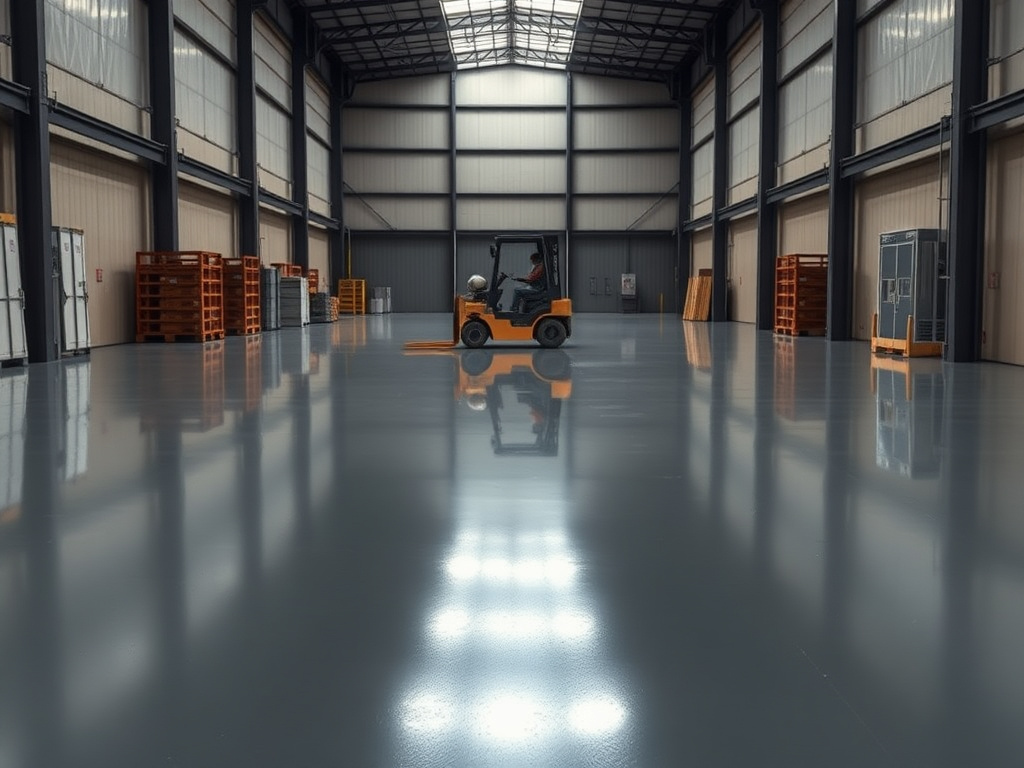
Commercial & industrial flooring
Commercial & Industrial Polyurea Floor Coatings
Warehouse, manufacturing, and processing floors take a different kind of abuse than any residential surface — sustained forklift traffic, dropped tooling, chemical spills, and shifts that never really stop. True polyurea is the spray-applied system built to take that load and get the floor back in service fast.
More than a garage-grade system
Why manufacturing and warehouse floors need more than a garage-grade coating
A lot of floor coating companies work from the same base assumption: start with a residential garage system, then scale it up for a bigger room. That approach works fine for a two-car garage that sees a passenger vehicle a few times a day. It falls apart fast on a warehouse floor that sees a loaded forklift every few minutes, a distribution center running three shifts, or a manufacturing plant where a dropped pallet of parts is a Tuesday, not an incident.
We build our commercial and industrial floor systems from the opposite direction — starting with the traffic, chemical exposure, and uptime requirements of a working facility, then specifying the polyurea system to match. That's a different engineering problem than a garage floor, and it's the one we specialize in statewide, from Phoenix-metro distribution hubs to manufacturing plants in Tucson, Flagstaff, and rural Arizona.
True polyurea is a plural-component, spray-applied elastomer — two components meet at the spray gun, react, and gel in seconds to minutes. That single property is what makes it structurally different from the rigid, liquid-applied epoxy systems most generalist coating companies default to. Epoxy cures over hours to days and stays relatively brittle once it does. Polyurea reaches a walkable, tack-free state in about an hour and keeps meaningful flexibility afterward, letting the floor absorb impact and minor slab movement instead of chipping at the surface.
For a facility manager, that difference shows up as fewer touch-up calls, less downtime to apply the coating in the first place, and a floor that handles the specific abuse a working facility delivers every day rather than the lighter use a residential floor system was actually designed around.
Built for real facility traffic
Impact, abrasion, and chemical resistance for forklift and heavy-equipment traffic
Every one of these performance factors is specified up front during the site assessment, not assumed from a single standard mix. A food-processing floor and a machine shop floor both need abrasion resistance, but they don't need the same chemical resistance profile — we spec the system to the facility, not the other way around.
| Cure / return-to-service | Gels in seconds to minutes and reaches a tack-free, walkable state within about an hour under typical conditions — a facility can often be coated overnight or over a weekend and put back into service far sooner than with a multi-hour-to-day epoxy cure. |
|---|---|
| Abrasion resistance | Formulated to hold up under sustained forklift, pallet-jack, and hand-truck traffic without the surface wear pattern that shows up early on a lighter-duty coating system. |
| Impact & flexibility | Elongates well beyond a rigid epoxy topcoat before failing, so dropped tooling, pallets, or equipment is far less likely to chip or crack the surface at the impact point. |
| Chemical exposure | Resists a broad range of oils, fuels, cleaning chemicals, and mild acids common to manufacturing, processing, and vehicle-service environments. |
| Temperature tolerance | Application chemistry is far less sensitive to hot or cold substrate and ambient conditions than epoxy, which matters for facilities anywhere from Yuma to Flagstaff and for unconditioned warehouse space in summer. |
| Finish options | Slip-resistant broadcast texture, solid-color topcoats, and line striping for aisles, staging areas, and safety zones — specified per facility, not a single fixed system. |
General performance characteristics of a properly specified plural-component polyurea floor system — confirmed against your facility's actual traffic and chemical exposure during a site assessment.
The fast-cure advantage
Coat over a weekend and resume operations without extended downtime
Downtime is the real cost of most facility floor projects — not the material, and not even the labor. A distribution center that has to shut a receiving bay down for three or four days for an epoxy system to cure is losing throughput the whole time, on top of whatever the coating itself costs. That's the problem polyurea's cure speed is built to solve.
Because true polyurea gels in seconds to minutes and reaches a walkable, tack-free state in about an hour, a facility floor can often be prepped, coated, and returned to service in a single overnight window or over a weekend — timing that a facility manager can actually plan a shift schedule around instead of shutting a line down for most of a work week.
Site Assessment
We walk the facility, document traffic patterns, chemical exposure, and any existing floor condition before specifying a system.
Phased Scheduling
Off-hours, overnight, or weekend application — and section-by-section phasing on larger facilities so operations can keep running.
Surface Prep & Application
Grinding, cleaning, and repair as needed, followed by plural-component spray application by trained technicians.
Cure Verification & Handoff
A cure and inspection step confirms the floor before the space is handed back for full operation.
Where this system is used
Applications across Arizona facilities
Every facility type has its own combination of traffic, chemical exposure, and uptime pressure, but the underlying system — plural-component, spray-applied polyurea — is the same one we scale differently for each:
- ✓Warehouses and distribution centers — sustained forklift and pallet-jack traffic across large open floor plans
- ✓Manufacturing plants — chemical exposure, heavy equipment loads, and continuous multi-shift operation
- ✓Food and beverage processing floors — wash-down cycles, moisture exposure, and sanitation-friendly seamless surfaces
- ✓Auto and fleet service bays — oil, fuel, and solvent exposure combined with vehicle and equipment traffic
- ✓Cold storage and unconditioned warehouse space — a wide temperature-tolerant cure window that isn't thrown off by an unheated or un-cooled building
- ✓Industrial mezzanines and staging areas — abrasion resistance and striping for defined workflow zones
Safety & workflow
Slip resistance, line striping, and wayfinding built into the floor system
A facility floor does more work than a garage floor ever will, and that includes communication — aisle boundaries, staging zones, pedestrian walkways, and safety-marked areas all need to be visible at a glance to anyone moving equipment across the space. We build those elements into the coating system itself rather than treating them as paint applied after the fact.
A broadcast texture profile added to the topcoat gives forklift operators and foot traffic real slip resistance in wash-down areas, loading docks, and anywhere spills are a routine part of operations — not an occasional accident.
Line striping for aisles, staging areas, and equipment lanes is specified and applied as part of the same project, using the facility's actual workflow as the reference rather than a generic layout. For multi-shift facilities, that clear visual structure carries real safety value beyond just looking finished.
We work directly with facility and operations managers to plan this scope around your shift schedule — phased, off-hours application that keeps the rest of the facility running while a section is coated, striped, and returned to service. For facilities that also need a fully-bonded, chemical-resistant liner for containment structures or processing floors handling active chemical exposure, see our secondary containment and chemical-resistant coatings page.
Frequently Asked
Industrial floor coating questions
How is a polyurea floor coating actually different from an epoxy floor coating in a warehouse or manufacturing facility?
+
The core difference is cure speed and flexibility. True polyurea gels in seconds to minutes and reaches a walkable state in about an hour, versus an epoxy system's multi-hour-to-day cure — and polyurea's elongation lets it absorb impact and minor slab movement instead of chipping or cracking under heavy equipment traffic the way a rigid epoxy topcoat can.
How fast can we get our floor back in service after a polyurea application?
+
Because polyurea's gel and cure times are measured in minutes rather than hours or days, most facility floors can be coated overnight or over a weekend and returned to normal operation far sooner than an epoxy-based system would allow. Exact timing depends on the specific product, area to be coated, and site conditions, which we confirm during the site assessment.
Can you coat our facility floor without shutting the whole operation down?
+
In most cases, yes. Phased application and off-hours or weekend scheduling let us section off and coat part of a warehouse, plant, or distribution center while the rest keeps running, then move to the next section on the same fast-cure schedule.
Do you offer slip-resistant texture and line striping for facility floors?
+
Yes — broadcast texture for slip resistance, solid-color topcoats, and line striping for aisles, staging zones, and safety wayfinding are all specified as part of the floor system, not add-ons bolted on afterward.
Get a bid for your facility floor
Tell us your facility type and approximate square footage and we'll scope a polyurea floor system built for your actual traffic and schedule — statewide across Arizona.
Go deeper
More on our process and industrial polyurea work
Polyurea for Arizona's Industrial & Infrastructure Sectors
The complete statewide guide to true polyurea for containment, infrastructure, agricultural, and commercial floor applications.
Secondary Containment & Chemical-Resistant Coatings
Seamless, chemical-resistant polyurea linings for containment structures and processing facilities.
About Arizona Polyurea Coatings
A true-polyurea specialty contractor serving industrial, municipal, agricultural, fleet, and residential clients statewide.