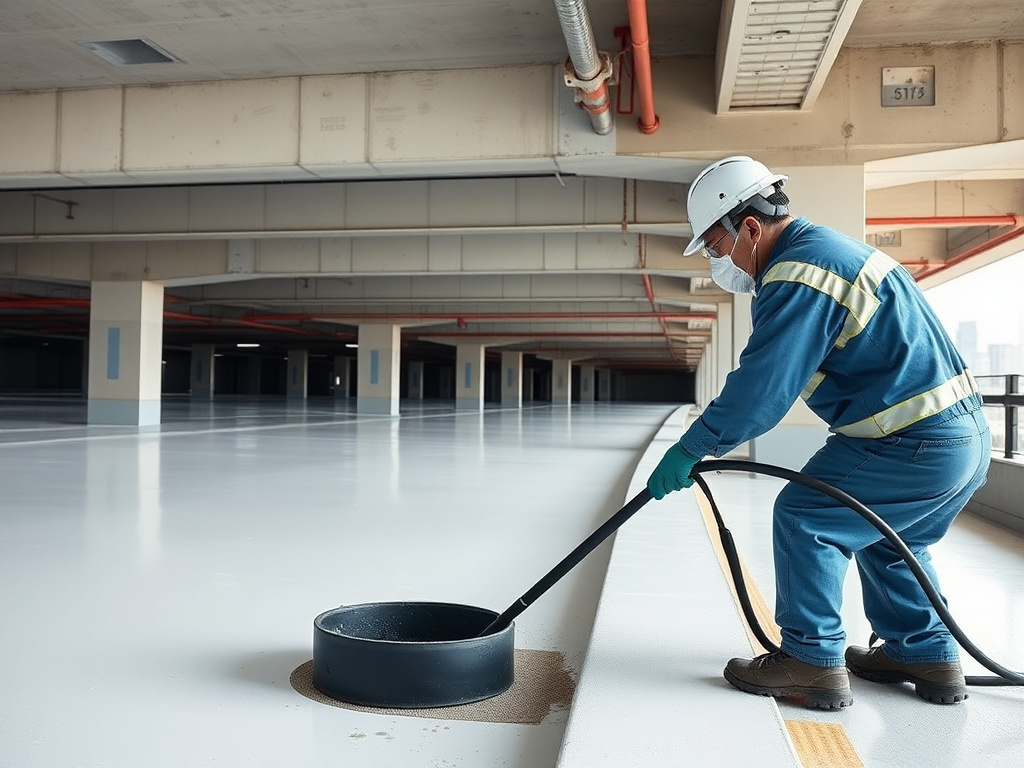
Vehicular-grade deck systems
Parking Structure & Traffic-Bearing Deck Polyurea Coatings
A parking structure's deck does two jobs at once: it carries constant vehicle traffic, and it's the waterproofing layer protecting the reinforced concrete and structural steel below it. A seamless, flexible polyurea membrane is built to do both — statewide, from a downtown Phoenix parking garage to a rural facility deck.
Why flexibility comes first
A parking deck needs a membrane that moves with the structure, not one that fights it
Parking structures aren't static slabs. Every level flexes under live vehicle load, expands and contracts through Arizona's wide seasonal and daily temperature swings, and moves at every expansion and construction joint the structural engineer built in on purpose. A rigid coating — one designed for a floor that never moves — meets that environment with the wrong mechanical properties from day one.
Rigid, thermoset systems like standard epoxy resist that movement rather than absorbing it. Under repeated deck flex, a rigid film eventually cracks, and once it cracks, water finds the crack. On a parking structure, that's not a cosmetic problem — a hairline crack in the coating is a direct path for water down to the slab, the rebar, and the levels below.
True polyurea is a plural-component, spray-applied elastomer, and elastomers are built to stretch. Polyurea commonly elongates several hundred percent before it fails, which means it bridges the small movements a deck makes every day — thermal cycling, live load deflection, minor structural settling — without the membrane itself cracking. That's a measurable mechanical difference from rigid coatings, and it's the reason true polyurea is the category most parking-structure engineers reach for rather than a hard floor topcoat.
It's the same reason we install it as a specialty rather than as one option among several general floor coatings — the plural-component spray equipment and trained application crew that true polyurea requires are the core of what we do, on parking decks and on the industrial and infrastructure work described in our statewide polyurea guide.
We treat a parking deck as a structural waterproofing project that happens to carry vehicle traffic, rather than a floor-coating project that happens to sit outdoors. The two framings lead to different decisions — different substrate testing, different joint detailing, and a different standard for what "finished" actually means once the crew leaves the site.
Waterproofing the structure below
The deck coating's most important job happens out of sight
A parking deck sits directly over occupied space, mechanical rooms, retail, or another parking level — and every one of those spaces depends on the deck above it staying watertight. Water intrusion through a cracked or seamed deck surface is the single biggest driver of long-term structural deterioration in a parking garage: it corrodes rebar, spalls concrete, and stains or damages whatever sits below.
A spray-applied polyurea membrane is fully bonded to the substrate and seamless across the entire deck. There's no joint, lap, or seam for water to migrate through the way there is with sheet-applied or seamed waterproofing systems — the membrane itself is the waterproofing layer, not a topcoat sitting on top of a separate waterproofing system underneath it.
That matters most on structures where the deck below is a ceiling for something else — retail space, a lower parking level, or building mechanical systems. Getting the waterproofing right the first time, with a membrane that can flex with the structure for years without cracking, is the difference between a deck coating that lasts and one that needs to be redone every few years.
Built for how each zone is actually used
Traffic-bearing membrane systems, by deck zone
Not every square foot of a parking structure takes the same abuse. Drive lanes see constant tire scrub and braking force; a standard stall sees far less turning stress; a pedestrian walkway needs slip resistance and wayfinding more than raw abrasion resistance. We spec the topcoat texture and traffic-wear rating by zone within the same overall membrane system, rather than treating the whole deck as one uniform surface.
| Vehicle drive lanes & entry ramps | Highest abrasion zone on the structure — constant tire scrub from turning and braking. Needs a wear-resistant topcoat over a flexible base membrane that can absorb repeated point loading without disbonding. |
|---|---|
| Standard parking stalls | Lower turning stress than drive lanes but still exposed to hot-tire contact and the same water and temperature cycling as the rest of the deck. Coated as part of the same monolithic membrane, not a separate patch system. |
| Ramps & sloped transitions | Slope changes concentrate braking and turning force in a small footprint. Slip-resistant texture is typically broadcast into the topcoat at these transitions specifically, not just applied uniformly across the whole deck. |
| Pedestrian walkways & stair landings | Same waterproofing membrane, different surface texture and color striping for wayfinding — kept visually distinct from vehicle lanes as part of the same coating system. |
| Expansion joints & construction joints | The structure's actual movement points. Detailed separately with joint-specific flexible systems rather than coated over as if the deck were a single rigid slab. |
General zone patterns — the specific system and texture for your structure is confirmed during a site assessment based on traffic volume, slope, and exposure.
Where decks actually move
Expansion joint and crack-bridging detail work
Expansion joints, construction joints, and existing cracks are the structure's actual movement points — the places engineered or already present to let the concrete expand, contract, and settle. A field membrane sprayed straight across a joint without a joint-specific detail will eventually split at exactly that line, because the joint is designed to move more than the surrounding slab.
- ✓Expansion joints detailed with a flexible joint system designed to move independently of the field membrane on either side
- ✓Existing cracks assessed and treated as active or non-active before coating, since an active crack needs a bridging detail, not just a fill
- ✓Control and construction joints in the original concrete pour mapped and detailed before spray application begins
- ✓Column bases, drains, and penetrations treated as their own detail work rather than coated over as flat field membrane
This detail work happens before the field membrane goes down, not after, and it's usually the part of a parking-deck project that determines whether the coating still looks and performs the same in five years — the field membrane rarely fails first; the untreated joint does.
Keeping the structure usable
Fast cure supports phased, lane-by-lane scheduling
Assess & section the deck
Map the structure into phases — by level, drive lane, or half of a deck at a time — based on how the facility needs to keep operating during the project.
Prep & detail one section
Grind, clean, and repair the substrate, then complete joint and crack-bridging detail work for that section before spray application begins.
Spray-apply the membrane
Plural-component polyurea gels in seconds to minutes, reaching a walkable and then drivable state far faster than an epoxy-based system on the same section.
Reopen & move to the next section
Return the coated section to traffic and move the crew to the next phase, keeping the majority of the structure usable throughout the project.
A parking structure rarely has the option to close entirely for the length of a multi-day coating project — the tenants, retail below, or the facility that depends on the parking supply need it open. Polyurea's fast cure is what makes lane-by-lane and level-by-level phasing realistic instead of theoretical: a section coated overnight can often carry vehicle traffic again the next morning, which is the schedule most parking structure owners actually need.
Where this system is used
Parking garages, stadium decks, rooftop parking, and plaza decks
Any structure that puts a deck between vehicle or heavy pedestrian traffic and occupied space below it is a candidate for a traffic-bearing polyurea membrane — statewide, not just in a single metro area.
- ✓Multi-level parking garages — commercial, municipal, hospital, and mixed-use
- ✓Stadium and venue decks carrying both vehicle and heavy pedestrian traffic
- ✓Rooftop parking decks exposed to full sun and Arizona's summer heat cycling
- ✓Plaza decks and podium structures built over retail, mechanical rooms, or another occupied level
- ✓Parking ramps and helical entry/exit structures where turning stress is concentrated
Getting started
Requesting a bid for a parking structure or deck project
Parking structure and traffic-deck projects are bid individually, based on square footage, deck condition, joint layout, and how the facility needs to phase the work. A site assessment confirms substrate condition, maps existing cracks and joints, and sets a section-by-section schedule before any material is spec'd.
We work directly with property managers, general contractors, and municipal and venue facility teams on these projects, and we back the finished membrane with a written warranty specific to the system installed. Learn more about how we approach statewide industrial and infrastructure work on our About page, or request a bid below.
Because our crews and mobile spray equipment travel statewide, the bid process is the same whether the structure is a downtown Phoenix parking garage, a Tucson medical campus deck, a venue in Flagstaff, or a facility near Yuma. Location doesn't change how the project is scoped or scheduled — it only changes the drive time to get the crew and equipment on-site.
Request a bid for your parking structure
Tell us the structure's size, level count, and current deck condition, and we'll come back with a scoped assessment and phased application plan.
Common questions
Parking structure & traffic-deck coating questions
Does the parking structure have to close completely during coating?
+
In most cases no. Traffic-bearing polyurea's fast cure supports phased, lane-by-lane or level-by-level application, so a garage can often keep sections open to traffic while other sections are being coated and returned to service.
How does a deck coating protect the structure below the parking level?
+
A seamless, fully-bonded polyurea membrane keeps water from tracking down through the slab to the rebar and structural steel below. Water intrusion through a cracked or seamed deck is what drives corrosion and structural deterioration over time — the membrane's job is to stop that path before it starts.
Is a traffic coating the same thing as a waterproofing membrane?
+
On a true polyurea system, yes — the same spray-applied membrane provides both the wear-resistant driving surface and the waterproofing layer for the structure underneath, rather than requiring two separate systems layered on top of each other.
How soon can vehicles drive on a coated deck?
+
Because polyurea gels in seconds to minutes and reaches a walkable, then drivable, state far faster than epoxy-based systems, return-to-service time is measured in a short window rather than days — the exact timing depends on the specific system and site conditions, confirmed during the assessment.