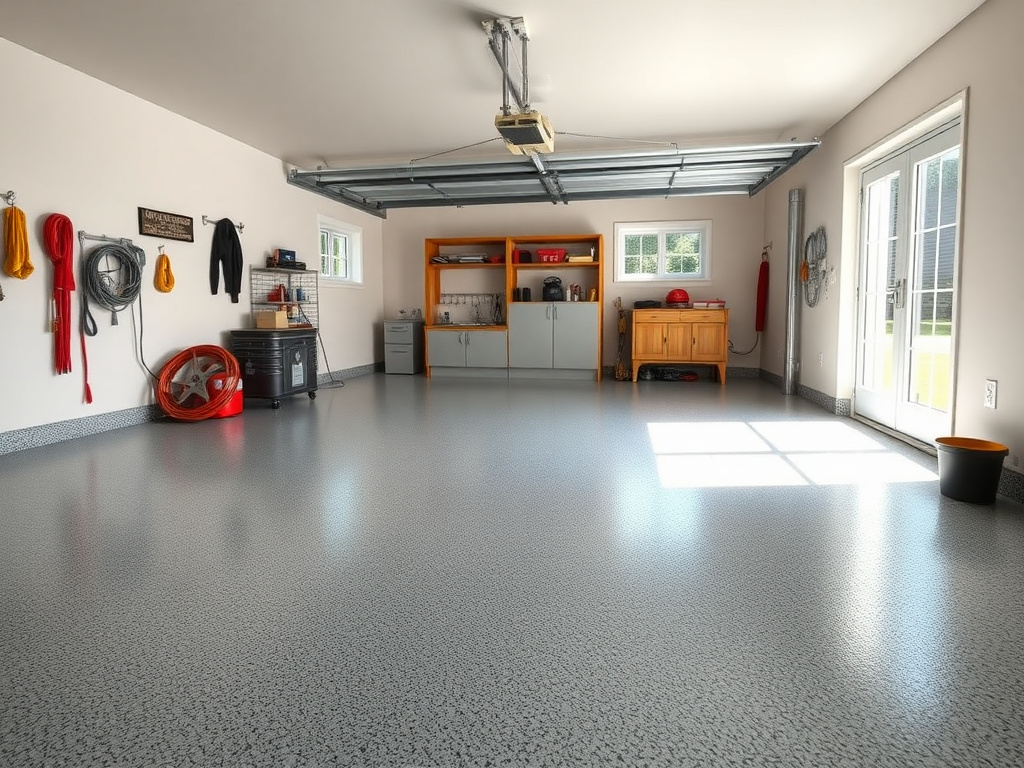
True polyurea, scaled to the home
Residential Garage & Driveway Polyurea Coatings
We're a true-polyurea specialty contractor first — the plural-component spray systems that waterproof water tanks and coat industrial floors across Arizona are the same systems we bring to a residential garage. Fast cure, real flexibility, and statewide service, not a Phoenix-metro-only garage-floor shop.
Same material, scaled down
Why we install true polyurea for garage and driveway floors
Most companies that coat residential garage floors are, at their core, general floor-coating shops — they default to epoxy or a polyaspartic hybrid because true polyurea's fast gel time requires purpose-built plural-component spray rigs and a trained crew to apply correctly. That equipment and training is our starting point, not an upgrade we occasionally offer.
We spray true polyurea on secondary containment structures, water tanks, and industrial floors across the state, and a residential garage floor uses that same base material and application process — a plural-component system that reacts and gels in seconds to minutes, applied by the same kind of crew and equipment. It's scaled to a two- or three-car garage instead of a warehouse, but it isn't a different, lighter-duty product.
That distinction matters more than it sounds like it should. A garage floor doesn't face the chemical exposure of a containment structure, but it does face the same slab-temperature swings, the same need for a seamless, fully-bonded surface, and the same practical want most homeowners have — get the project done and get the car back in the garage — that fast-curing, flexible polyurea is built to deliver.
For the deeper technical case behind why true polyurea behaves so differently from epoxy in the first place — cure speed, flexibility, and seamless bonding — see our statewide polyurea guide, which covers the same material science we apply here at a residential scale.
We're not asking homeowners to choose between three different chemistries the way a general floor-coating shop might. We install one category, true polyurea, because it's the material and process we've built our equipment and crews around — the same way we approach a secondary containment structure or a water tank lining. A garage floor is a smaller, simpler version of that same job, not a separate product line with a separate standard.
Cure speed
Walkable in minutes, back in the garage far sooner than epoxy
Cure speed is the single biggest practical difference homeowners notice. A true polyurea system gels within seconds to minutes of spray application and typically reaches a tack-free, walkable surface within about an hour — a fundamentally different chemistry than epoxy, which needs a multi-hour-to-day cure window before it can handle foot traffic, let alone a vehicle.
In practice, that means a garage floor project doesn't have to turn into days of a car parked in the driveway or on the street. Once the coating has reached its vehicle-ready state — confirmed on-site for the specific product used — the garage goes back into normal use. For a household with one garage and no second place to park, that turnaround time is often the deciding factor in choosing true polyurea over a slower-curing alternative.
Built for Arizona heat, not just Arizona style
Flexibility and impact resistance for real Arizona slab conditions
An Arizona garage slab isn't a stable, climate-controlled surface. It swings from cool overnight temperatures to a hot, sun-loaded slab by mid-afternoon for months at a time, and a driveway sees that swing without even the partial shade of a garage structure. Rigid coatings can respond to that daily and seasonal cycling with cracking, or with hot-tire lifting — the small bubbles and peeling that show up where a warm tire sits on a rigid film that can't flex with the slab underneath it.
True polyurea's elongation — commonly several hundred percent before it fails — is a mechanical answer to that specific problem, not a marketing point. A membrane that can stretch handles the expansion and contraction of a slab through a Phoenix summer or a Flagstaff winter without the cracking or lifting that shows up on a rigid coating over time.
It's also a real answer to everyday impact and abrasion — dropped tools, a jack stand, a bike kickstand, or a trailer tongue resting on the driveway. A flexible, fully-bonded membrane absorbs that kind of point impact rather than chipping or cracking around it the way a rigid coating can.
A driveway carries its own version of the same stress test — vehicle weight concentrated on four small contact patches, parked in the same spots day after day, on a slab that's baking in direct sun with none of a garage's shade. A seamless, flexible membrane bonded across the full surface handles that repeated point loading without the localized failure that shows up on a rigid coating exposed to the same conditions.
Because this temperature tolerance is a chemistry advantage and not a location- specific trick, it performs the same way whether the install is in Phoenix, Tucson, a rural property near Yuma, or a driveway at altitude near Flagstaff — see our service areas for how that plays out region by region across the state.
What the install actually looks like
From assessment to a cured, inspected floor
Site assessment
We check the slab's condition, existing coatings, moisture, and any cracks or oil staining that need addressing before a new coating goes down.
Surface preparation
Mechanical grinding and cleaning to open the concrete's surface profile so the polyurea forms a true mechanical and chemical bond, plus repair of any cracks or spalled areas.
Spray application
Plural-component polyurea is proportioned and sprayed on-site, with color flake or quartz broadcast into the coating if that finish is selected.
Cure & inspection
The membrane gels in seconds to minutes and reaches a walkable state within about an hour; we confirm the surface is fully cured and inspect the finished floor before handoff.
Most residential garage and driveway projects are completed in a single day of on-site work, start to finish — the assessment and any needed crack repair happen up front so the spray application itself moves quickly once the crew is on-site.
Finish options
Flake and color options, on the same true polyurea base
The finish is a design choice layered on top of the same base material and process described above — none of these options change the underlying polyurea system's cure speed or flexibility.
| Full broadcast flake | Vinyl color chips broadcast to full saturation across a base polyurea coat, then sealed under a clear topcoat — the most common finish for garage floors, hides minor substrate imperfections well. |
|---|---|
| Color quartz blend | Quartz granules blended into custom color combinations for a more textured, natural stone-like look, sealed under the same clear topcoat. |
| Solid color topcoat | A single, uniform color with no broadcast material — a cleaner, more minimal look often chosen for driveways, patios, and walkways. |
| Custom color blends | Flake and quartz colors mixed to match a specific palette — brand colors for a home business, or a blend that ties into existing exterior finishes. |
Available on garage floors, driveways, walkways, and patios — the right finish depends on the surface and the look you want.
Where we do this work
Garages, driveways, walkways, and patios — statewide
Residential polyurea coating is one of several lines of business we run alongside our industrial and infrastructure work, and we take it to the same statewide footprint — not just the Phoenix metro area. A homeowner outside the Valley shouldn't have to settle for a lower-grade product or a longer wait just because a garage-floor project is further from a metro hub — the same mobile spray equipment and crew that travel to an agricultural facility or a water infrastructure site travel to a residential job as well.
- ✓Garage floors — one, two, three, or more car bays, in any finish
- ✓Driveways — full driveway or approach-and-apron sections
- ✓Exterior walkways and entryways
- ✓Patios and covered outdoor living spaces
- ✓Phoenix metro, Tucson, Flagstaff and northern Arizona, Yuma, and rural properties statewide
Getting started
Requesting a residential quote
Residential garage and driveway projects move through a straightforward quote process — tell us the space, current floor condition, and finish you have in mind, and we'll follow up with pricing and scheduling. It's a simpler process than the bid process we run for commercial, municipal, and industrial projects, but it uses the same crews and the same true polyurea material.
Read more about our approach to statewide polyurea work on our About page, or request a free quote below.
Because we run the same crews and mobile spray equipment across residential, commercial, and industrial work, scheduling a residential project doesn't mean waiting behind a separate, smaller operation — it's built into the same statewide dispatch we use for containment structures, water tanks, and parking decks. Whether you're in Phoenix, Tucson, Flagstaff, Yuma, or a rural property in between, the process and the material are the same.
Get your free residential quote
Tell us about your garage, driveway, walkway, or patio and we'll follow up with pricing, finish options, and scheduling — no obligation.
Common questions
Residential polyurea coating questions
Do you install true polyurea on residential garage floors, or just commercial and industrial work?
+
Both. The same plural-component, spray-applied polyurea material and process used on our secondary containment, infrastructure, and commercial floor projects is used for residential garage and driveway coatings — scaled to the home, not a different, lighter-duty product.
How long before I can park in my garage after a polyurea coating?
+
Because polyurea gels in seconds to minutes and cures far faster than epoxy, vehicle-ready times are typically measured in hours rather than the multiple days some epoxy systems require. Exact timing depends on the specific product and site conditions, which we confirm on-site.
Will a polyurea garage floor hold up to Arizona summer heat?
+
Yes — polyurea's reaction chemistry and flexibility are far less sensitive to hot slab and ambient temperatures than rigid coatings like epoxy, which is one of the reasons we apply it statewide from Yuma to Flagstaff rather than treating it as a Phoenix-only product.
What color and finish options are available?
+
Full broadcast flake, color quartz blends, solid color topcoats, and custom color combinations are all available — the finish is a design choice layered on top of the same true polyurea base system.