AZ Polyurea Coatings Editorial Team · Published August 1, 2026 · 9 min read
Most facility managers only start researching secondary containment coatings after something has already gone wrong — a cracked berm, a liner that's pulling away at a seam, or an upcoming inspection that flags a containment structure as due for repair. That's a reasonable way to end up here, but it also means a lot of first-time research happens under time pressure, with vendor pitches from three different coating categories all claiming to be the obvious answer. This is meant as a more neutral starting point: what containment coating is actually for, why traditional seamed liners tend to fail where they fail, what a fast-cure material changes about a facility's downtime, and what to expect from a bid and assessment process.
None of this assumes a specific facility type. The same basic questions apply whether the structure in question is a chemical storage dike wall, a tank-farm containment berm, a loading and unloading pad, or a processing floor with secondary containment requirements built into the slab design.
What secondary containment coating is actually for
Secondary containment is a structural concept before it's a coating question: a berm, dike wall, or contained pad designed to hold whatever a primary tank or process vessel would release if it ever failed, keeping it from spreading into soil, groundwater, or storm drainage. The concrete or steel structure provides the physical containment volume. The coating's job is to make that structure actually hold the substance it's meant to hold — bare concrete is porous and will absorb and eventually let through many of the chemicals a containment structure is built to contain, and bare steel corrodes on contact with a wide range of industrial fluids.
A containment lining, in other words, is what turns a concrete berm from a physical barrier into a functional one. Get the coating wrong — wrong chemistry, wrong application, wrong seam detail — and the structure can still fail its actual job even though the concrete itself looks intact.
Why seams are the usual failure point in traditional liner systems
If there's one pattern that shows up across almost every failed containment liner a facility manager will eventually encounter, it's a failure that starts at a seam. Sheet-applied liners, panel systems, and field-seamed geomembranes all require joining individual pieces of material together somewhere — at a heat-welded seam, an adhesive overlap, or a mechanically fastened detail — and every one of those joints represents a potential path for whatever the containment structure is holding to migrate through the lining, even when the sheet material itself remains fully intact.
That risk concentrates hardest at exactly the details containment structures are full of: wall-to-floor transitions, sump penetrations, pipe and conduit penetrations, corners, and expansion joints. A flat, uninterrupted floor is the easiest place to seam a liner correctly. A containment berm with a dozen penetrations and transitions is the hardest — and it's also usually the structure with the least tolerance for a failure, since it's specifically there to catch whatever a primary containment failure releases.
A true, spray-applied polyurea membrane addresses this differently, not just better. The material is applied as a continuous, fully-bonded film that conforms to the substrate as it's sprayed — following penetrations, corners, and transitions as one monolithic surface rather than a series of joined sheets. There's no seam because there's nothing to seam; the lining is applied, not assembled.
Chemical and abrasion resistance for active facilities
The other half of the containment-coating question is material chemistry: does the lining actually hold up against what the facility handles. True polyurea resists a broad range of acids, fuels, solvents, and other industrial chemicals, and it holds up under the kind of foot and vehicle traffic that containment areas, loading pads, and processing floors see day to day. It also elongates significantly before failure, which lets the membrane bridge minor substrate cracking and absorb ordinary structural movement rather than splitting along with the concrete beneath it — a real consideration on containment structures that see thermal cycling or vibration from adjacent equipment.
| Containment berms & dike walls | Seamless interior lining across walls, floors, and transitions in a single continuous membrane. |
|---|---|
| Loading & unloading pads | Chemical- and abrasion-resistant surfacing for areas exposed to spills, drips, and vehicle traffic. |
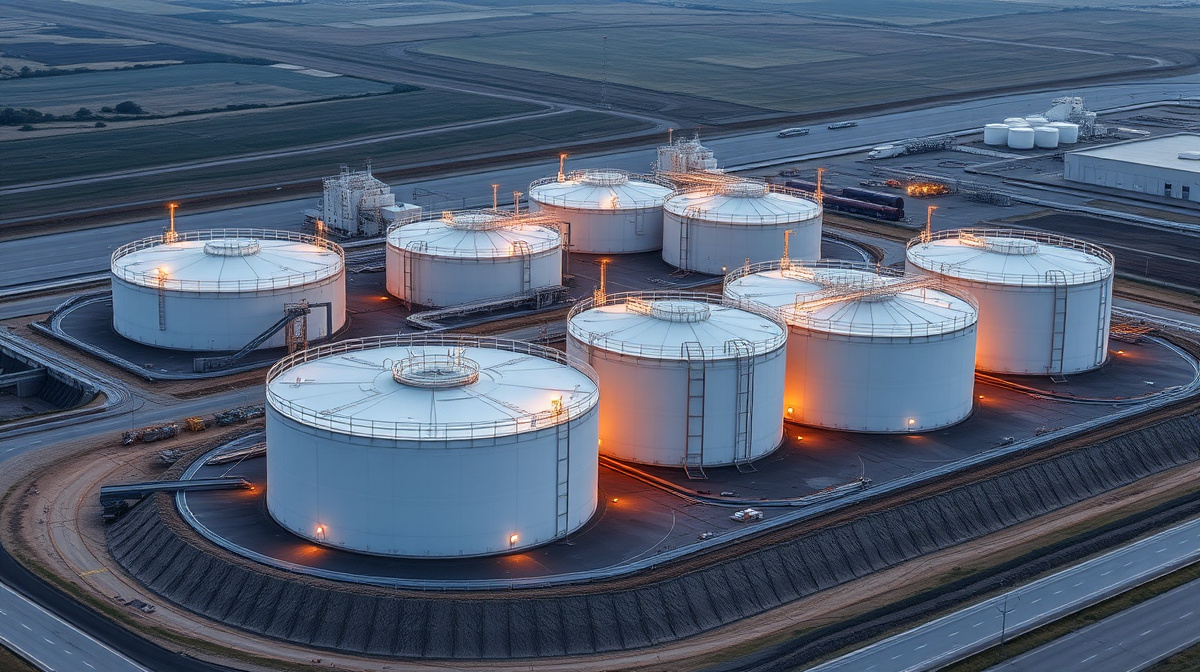
| Tank farm containment | Lining for the containment area surrounding storage tanks, sized to the facility's structure. |
| Chemical storage & processing floors | Fully-bonded floor systems for areas handling acids, fuels, solvents, and other process chemicals. |
Exact material formulation and application detail vary by chemical exposure profile — confirmed during the site assessment.
Why fast cure matters more than it sounds like it should
Cure speed sounds like a minor operational detail until it's the thing standing between a facility and a multi-day shutdown. Traditional epoxy containment coatings typically need anywhere from several hours to a full day or more before an area can be walked on, and considerably longer before it can handle chemical exposure or vehicle traffic again. On a facility that runs production around a fixed containment area — a loading pad that trucks need daily, a processing floor that's part of an active line — that cure window can mean planning a shutdown around the coating work rather than the other way around.
True, plural-component polyurea reacts in seconds and reaches a tack-free, walkable state within minutes to about an hour, depending on formulation and ambient conditions. That doesn't eliminate planning — full chemical and heavy-traffic readiness still takes longer than simple foot-traffic readiness, and any responsible contractor will give a facility manager a realistic return-to-service timeline rather than an oversold one. But it does compress the practical downtime window from days down to a single shift or an overnight window in many cases, which is the difference between coating work that fits around a facility's schedule and coating work that the facility has to shut down for.
- ✓Fast gel and tack-free time shortens the window an area is out of service.
- ✓Off-hours or overnight scheduling is realistic for many containment and pad projects.
- ✓Phased application lets one section stay in service while another is being coated.
- ✓A seamless membrane means no post-cure seam inspection or seam-sealing step to schedule separately.
How the site assessment and bid process actually works
Containment coating work almost always starts with a site visit rather than a quote based on a floor plan or a phone description — the chemical exposure profile, substrate condition, and structural detail of a containment area vary too much facility to facility to bid accurately any other way. A typical process looks like this:
Site assessment
An on-site evaluation of the containment structure, substrate condition, chemical exposure profile, and access constraints.
Substrate preparation & testing
Surface preparation and substrate testing for concrete or steel, including moisture and profile checks appropriate to the material.
Phased spray application
Plural-component polyurea applied by trained crews, phased around active operations where the facility needs to stay running.
Cure verification & documentation
Inspection and documentation of the finished membrane before the area is returned to full chemical and traffic service.
Facility managers evaluating bids for the first time should expect a scoped, written plan tied to the specific structure and chemical exposure involved — not a per-square-foot number quoted sight unseen. A contractor that skips the site assessment step is either working from an incomplete picture of the job or padding the number to cover for the unknowns, and neither is a good sign for how the actual application will go.
Working around an active facility
Very few containment or processing areas can simply close for the duration of a coating project, which is why phased and off-hours application is the norm rather than the exception on real facility work. A containment berm can often be divided into sections so one part stays available while another is being prepared and coated. Loading pads and processing floors are frequently coated overnight or across a weekend specifically so a facility doesn't need to interrupt its regular operating schedule. None of that planning is unique to polyurea, but the material's fast cure is what makes tight phased scheduling realistic in the first place — a coating that needs a full day to reach walkable state doesn't fit into an overnight window no matter how carefully the project is phased.
Questions worth asking before you sign off on a containment coating bid
A facility manager doesn't need to become a coatings chemist to evaluate a bid responsibly. A short list of direct questions tends to separate a contractor who understands true polyurea containment work from one who's treating it as an upsell on top of a standard epoxy floor job:
- ✓Is the material a true, plural-component polyurea, or a polyurea-modified epoxy or polyaspartic hybrid marketed under a similar name?
- ✓What is the crew's actual experience with the specific chemical(s) this containment structure is designed to hold?
- ✓How will penetrations, sumps, and wall-to-floor transitions be detailed, and why does that method avoid a seam at those points?
- ✓What does the substrate preparation and testing step look like for this specific concrete or steel structure?
- ✓What documentation will be provided after application — inspection records, material lot information, cure verification?
- ✓What is the realistic return-to-service timeline for foot traffic, vehicle traffic, and full chemical exposure, specifically?
None of these questions require a contractor to disclose proprietary formulation details. They're simply the kind of specifics a contractor who's done this work before will answer without hesitation — and the kind that a generalist floor-coating company defaulting to whatever material it normally sprays will often struggle to answer with any precision.
Getting a containment lining right the first time matters more than it does on a lower stakes floor-coating job, simply because of what the structure is there to catch if it fails. A seamless, chemically appropriate membrane installed by a crew that understands both the material and the facility's operating constraints is the practical goal — everything above is aimed at helping a facility manager recognize whether a given bid is actually built around that goal.