AZ Polyurea Coatings Editorial Team · Published August 1, 2026 · 9 min read
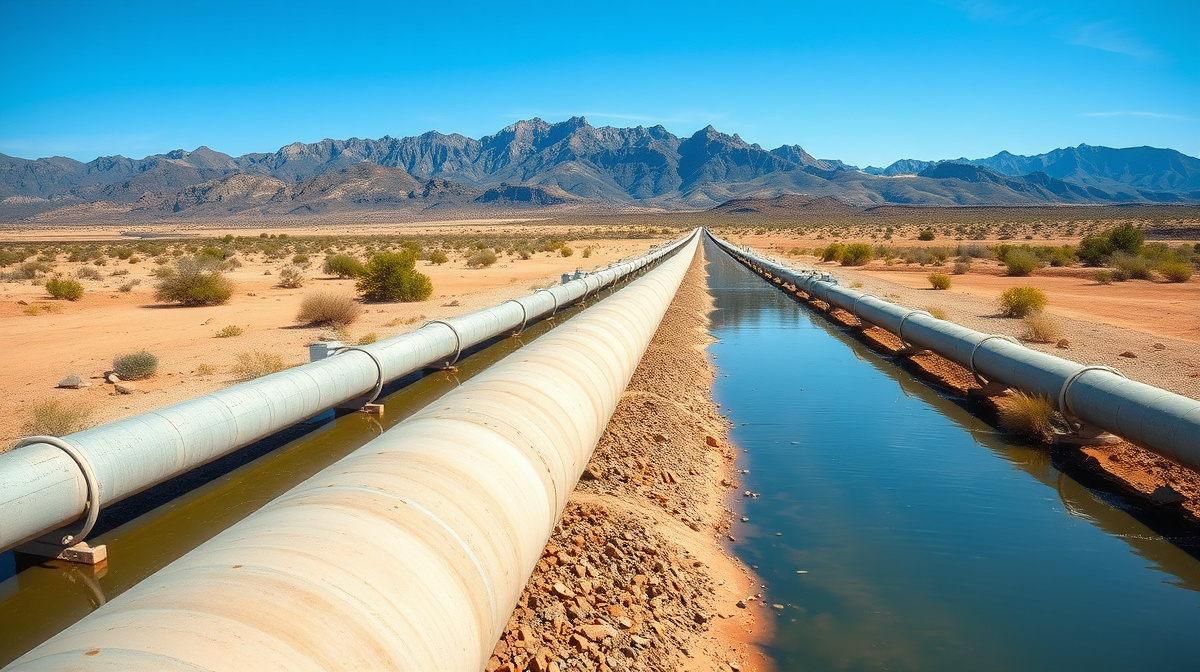
Arizona moves an enormous amount of water across an enormous amount of desert, and it does most of that moving through infrastructure that was built to last decades, not forever. Canals, concrete and steel tanks, culverts, lift stations, and treatment structures all share the same basic problem over a long enough timeline: joints open up, seams separate, concrete spalls, and coatings that were never meant to flex end up cracking right along with the structure underneath them. None of that is unique to Arizona. What is somewhat unique is the scale of the system involved, and the fact that a meaningful amount of that system is currently in an active rehabilitation and expansion cycle at the same time.
That combination — aging concrete and steel infrastructure, plus real capital already moving into canal, pipeline, and tank projects statewide — is exactly the backdrop against which seamless, spray-applied polyurea has become a serious option for water and wastewater asset owners, alongside more traditional seamed liner systems. This isn't a sales pitch for a specific project; it's an explanation of why the material category itself is a logical match for the kind of infrastructure Arizona actually runs on.
Arizona's canal system carries the state, and it's enormous
The backbone of central and southern Arizona's water supply is the Central Arizona Project (CAP), a roughly 336-mile canal system that moves Colorado River water across Maricopa, Pinal, and Pima counties using a series of 14 pumping plants to lift water over the elevation changes between the river and the cities and farmland it serves. CAP water supports both municipal supply for Phoenix and Tucson and roughly a million acres of irrigated agricultural land — meaning the canal system isn't a single asset with a single owner and a single failure mode. It's a shared piece of infrastructure that a large share of the state's population and agricultural economy depends on staying watertight, every day, for decades at a stretch.
A system built at that scale, on that timeline, inevitably accumulates the kind of wear that shows up as a maintenance and rehabilitation workload rather than a single project. Concrete canal linings crack and spall with age and thermal cycling. Joints between sections open. Steel and concrete tank interiors corrode or develop pinhole leaks long before the structure itself is due for replacement. None of this is a crisis — it's the ordinary lifecycle of large water infrastructure — but it does mean there's a standing, ongoing need for rehabilitation work across the system, not a one-time event.
A statewide capital cycle is already underway
That ordinary maintenance need is currently overlapping with a genuinely active investment cycle. A coalition of roughly 14 central-Arizona municipalities and water companies has received federal Inflation Reduction Act funding — reported at around $154 million — to interconnect the CAP and Salt River Project (SRP) canal systems, and a new SRP pipeline intended to improve access to stored groundwater during dry periods was reported online in mid-2026. Individually, each of those is a specific infrastructure project. Collectively, they signal something broader: canal interconnection, new pipeline construction, and tank and reservoir work are all moving forward across central Arizona at the same time, not as isolated repairs but as part of a coordinated push to make the state's water delivery network more resilient to drought and demand growth.
We want to be precise about what that does and doesn't tell a facility manager or water-district engineer reading this. It doesn't mean every tank or canal segment in the state is scheduled for rehabilitation on a known timeline — we're not aware of a published, itemized list like that, and we wouldn't invent one. What it does mean is that the underlying condition driving this investment — aging canal and pipeline infrastructure that needs rehabilitation to keep pace with a growing, drought-pressured state — is real, current, and unlikely to be a short-term phenomenon. An asset owner evaluating lining or rehabilitation options today is operating in the middle of that cycle, not ahead of it or behind it.
Where a seamless polyurea membrane actually fits
Polyurea earns a place in this conversation because of what happens when it's applied, not just because it's a newer material. True, plural-component polyurea is spray-applied directly onto a properly prepared substrate, where it reacts and gels in a matter of seconds and reaches a tack-free, walkable state within minutes to about an hour depending on formulation and conditions. That application method produces a monolithic, fully-bonded membrane with no seams, no overlaps, and no mechanical fasteners — which matters enormously on structures where the entire point of the lining is to keep water in (or out) across an irregular, often imperfect concrete or steel surface.
| Potable & non-potable water tanks | Interior linings for storage tanks and reservoirs, applied as a continuous membrane rather than panel-by-panel. |
|---|---|
| Secondary & agricultural canals | Seamless waterproofing over irregular concrete canal sections and transitions, where seamed liners are harder to fit tightly. |
| Culverts & lift stations | Interior coating for structures that combine constant moisture exposure with irregular geometry and confined access. |
| Treatment-facility structures | Chemical- and moisture-resistant linings for basins, channels, and structures at wastewater and treatment facilities. |
Application details vary by structure type, substrate condition, and potable-contact requirements — every project starts with a site assessment.
Why seams are the usual failure point in traditional liner systems
Traditional water-infrastructure liner systems — sheet membranes, panel liners, seamed geomembranes — perform well on paper, but almost every real-world failure on that class of product traces back to the same place: the seam. Sheet and panel materials have to be joined somewhere, whether that's a heat-welded seam, an adhesive overlap, or a mechanically fastened joint, and every one of those joints is a potential path for water to migrate through the lining even when the sheet material itself is intact. On a flat, regular surface with careful installation, seams can hold up well. On the kind of irregular concrete canal sections, tank penetrations, and transition details that make up most real water infrastructure, seams are exactly where problems concentrate.
A spray-applied polyurea membrane sidesteps that failure mode structurally, not just through better materials — there's no seam to migrate through because there's no seam. The coating conforms to the substrate as it's applied, following penetrations, corners, and irregular geometry as a continuous film rather than a series of joined pieces. That's the core argument for polyurea on canal, tank, and treatment-structure rehabilitation: it isn't a marginally better version of a seamed liner, it's a different structural approach to the same waterproofing problem.
- ✓No field seams, welds, or mechanical fasteners for water to migrate through over time.
- ✓Conforms to irregular canal sections, tank penetrations, and transition details in a single continuous pass.
- ✓No separate seam-inspection or seam-sealing step to schedule after the initial application.
- ✓One monolithic membrane rather than a system of joined panels or sheets.
Flexibility, chemical resistance, and Arizona's temperature swings
Water infrastructure moves — thermally, structurally, and sometimes seismically — and a rigid lining that can't flex with that movement eventually cracks along with the substrate. True polyurea commonly elongates several hundred percent before failure, which lets a properly applied membrane bridge hairline cracks and absorb ordinary structural movement in tanks, canals, and treatment structures without splitting. That same chemistry also resists a broad range of chemicals relevant to water and wastewater environments and holds up under abrasive flow conditions, which matters for canal sections and treatment-facility channels that see continuous water movement and occasional sediment load.
Arizona adds one more variable that many liner systems aren't built around: an unusually wide statewide temperature range, from Yuma and Phoenix summer heat to Flagstaff and northern Arizona winter cold. Epoxy-based systems in particular are sensitive to substrate and ambient temperature during application. Polyurea's reaction chemistry is markedly less sensitive to those swings, which is part of why it travels well to water infrastructure projects anywhere in the state rather than being a Phoenix-metro-only solution.
How a municipal, district, or utility coating project actually runs
Water infrastructure work carries a different process than a commercial floor or a residential garage, mostly because of who owns the asset and what's riding on it staying in service. A typical project sequence looks like this:
Site assessment
An on-site evaluation of the structure, substrate condition, and any potable-contact or material-compatibility requirements specific to the asset.
Substrate preparation & testing
Surface preparation and substrate testing appropriate to concrete or steel, including moisture and profile checks before any material is applied.
Plural-component spray application
The polyurea membrane is applied by trained crews using heated, proportioned spray equipment built for the material's fast reaction time.
Cure verification & documentation
Post-application inspection and documentation of the finished membrane, including any records a municipal or utility owner needs on file.
For potable-water applications, material selection has to account for contact requirements appropriate to drinking-water infrastructure — a detail that gets confirmed during the assessment phase rather than assumed up front, since it depends on the specific structure and its use.
Minimizing disruption on infrastructure that can't simply go offline
Municipal water infrastructure rarely has the luxury of a long, open-ended shutdown window. Canal sections, tanks, and lift stations are frequently part of an active supply chain that serves cities, farms, or both — which is precisely where fast-curing polyurea has a practical advantage over slower-curing alternatives. A membrane that reaches a tack-free, workable state within minutes to about an hour shortens the return-to-service window considerably compared with multi-hour or multi-day cure times for other coating categories, which in turn narrows how long a tank, channel, or canal segment needs to sit out of rotation.
None of that eliminates planning work — phased application, off-hours scheduling, and coordination with a utility's own operations calendar are still part of any real project on active infrastructure. But it does change the scope of what's realistic to schedule, which matters on a system where taking an asset fully offline has knock-on effects for everyone downstream of it.